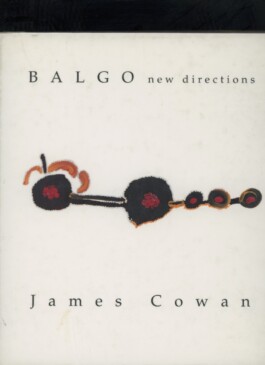
Published in 1999
by Craftsman House, Australia
Printed in Singapore
ISBN 90 5703 61 18
Hardback, 144 pp.
241mm(w) x 271mm(h)x 15mm(d)
I looked up the author: James Cowan, a writer, a white Australian born in Naarm (Melbourne). He has written a series of Australian settler novels123. And also books outlining Aboriginal cosmology4 including ones that formed part of a series of anthropological writings on shamanism.
This provides an uncomfortable relation to authority on the subject, as a cultural/spiritual outsider. It seems to point to a problem in the knowledege production that happens through books and publishing and the ways in which it produces legitimacy.
I think about the debate around Bruce Pascoe5 for his book Dark Emu6 (which connects again to the media tycoons who funded 759.994 AUS) and how legitimate criticisms7 became an excuse or opened a floodgate for racist and personal abuse*.
What reception did Cowan's books recieve in the 1990s? Did any of his books on Aboriginal culture receieve similar backlash and what does that say about how much his books may or may not have been reiterating the status quo on how Aboriginal culture is understood, experienced (or not) and valued in mainstream Australian culture and politics.
Cowan spent time living with the Blago Hills community represented in this book, he worked to reinvigorate the art centre, Warlayirti Arts and lifted the earnings for the Warlayirti artists to a level not previously seen in the industry. Warlayirti Artists is still one of the most successful Indigeous run art co-ops.8
* You can search for 'Dark Emu debate' online and it won't take long to find white supremacism pretending to be legitimate critcism.
Scan of the first painting the book.
John Mosquito Tjapangarti
Yuramaal, Great Sandy Desert, WA
1995, acryllic on canvas, 90 x 60cm
Notes on painting from the book:
This painting depicts a senior law story about hte Tingarri initiated men travelling across country †at a time of Dreaming (Tjukurrpa). John is a 'rain man', and so is responsble for the making of rain in this region. Much of the painting is secret-sacred and cannot be revealed.
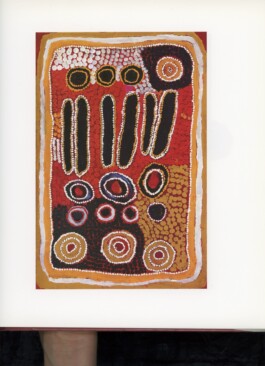
Scan of the first painting in 759.994 BAL
John Mosquito Tjapangarti, Yuramaal, Great Sandy Desert, WA. 1995, acryllic on canvas, 90 x 60cm
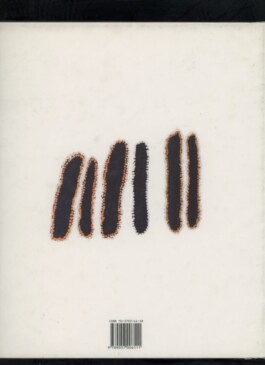
Back cover of 759.994 BAL
Front cover of 759.994 BAL
Binding and Cover
Case bound (hard back), covered in a warm red bookcloth with a full colour printed dust jacket. The dust jacket is secured to the book with the library's protective plastic wrap and so it is impossible to see what is printed or foil blocked onto the cloth covers and spine. The book is section sewn, with a warm yellow headband and dark ochre coloured, uncoated endpapers.
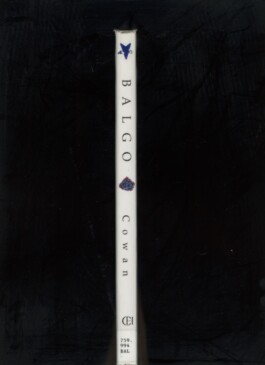
Spine of 759.994 BAL
Pages
Printed full colour on matte coated stock, typical for art publications reproducing artwork on the page. Although tastes have changed since then and coated stocks are not as ubiquitous in art publishing as they once were. This may be due to the rise in digital printing and toner based processes which leave a further coating on the page and therefore the use of an uncoated stock to print litho images is now a way of clearly signalling a more expensive, more traditional and in most cases much higher quality print finish. It is also a better stock choice for a mix of text and imagery as there is no potential for glare.